Real experiences on the Ukrainian front line become this gripping novel from a bestselling author

‘Nam pizda,’ says Rat.
We’re fucked. He’s peeking at the sky through a gap in our pit’s entrance, which is camouflaged with trash and sod.
Nearby flows the Dnipro, father of you all, eternal, slow with heavy waters and clumps of ice, moving despite the dams submerged beneath the floodwaters’ cataracts. Overhead, the night shines with the full face of your mother the moon, and suspended in her glow is a drone, a medium-sized bomber with thermal vision.
One of yours.
One of yours, because when its black eye sees the white heat of Rat leaning out of your pit, instead of a grenade it drops an empty two-litre Coke bottle, wrapped in duct tape for some reason, and then, with a whine of its propellers, it tilts and flies back to where it came from, on the far bank of the great river. The bottle lands in the mud a few metres from our pit. Rat shakes his head, disgusted at the pilot’s sloppy work, then pauses for a moment, listening out for other, foreign drones.
The silence is broken only by the murmur of the great river and the distant thunder of incoming Russian artillery, and the even more distant rumble of yours, from the opposite bank, like a faraway storm.
‘That’s our arta working,’ says Rat, trying buck himself up.
‘Ours,’ you agree.
Work, that’s what this war amounts to now, the arta working while you two hang out in a pit and wait for their arta to go to work on you.
Rat slowly slips out of the pit, pushing aside the entrance camouflage, then crawls on the ground toward the bottle, moving both quickly and ponderously because of the mud, like a huge amphibian, dirty grey in faded MultiCam. He grabs the bottle and hurries back to the pit, a giant newt in a bronik and a helmet.
You turn off your little red headlamp, take out the folding knife your sister gave you before you left for your 42nd birthday, though you weren’t celebrating your birthday, because by then you couldn’t celebrate your birthday, though you hadn’t yet gone to war, you were only driving around delivering humanitarka.
It’s a really good knife, you know it was pricey, you sharpen it often with a little ceramic whetstone, so now you have no trouble cutting the tape holding both halves of the bottle together. Inside are the contents of two American MRE military rations, removed from their usual multipack so they could fit inside the bottle along with a pack of cigarettes, a lighter and a little piece of paper with a handwritten note from your kombat: ‘Look after yourselves, boys.’ These words are written in Ukrainian. Because you never went to a Ukrainian school you can’t read Cyrillic handwriting, only print, but Rat can, because he did go to a Ukrainian school, and he reads the kombat’s disgustingly insolent words out to you.
Бережіть себе, хлопці. Look after yourselves. How can you look out for yourselves on the wrong side of the river?
‘Fuck him,’ you say.
You don’t know if the kombat wrote it out of stupidity or sarcasm, but you don’t like it at all.
‘Fuck ’im,’ agrees Rat.
Rat fishes around in the airdropped package.
‘No water,’ he finally says.
‘They’ll bring water too. Or else I’ll go to the river.’
‘You won’t come back from the river.’
‘Probably not.’
You both say nothing for a good while, knowing that what you’re saying nothing about is the situation you’ve found yourselves in, because it’s hard to say anything about it, but also hard to ignore it.
‘Nam pizda,’ says Rat again after a while, still staring at the contents of the airdrop, as if there was something unusual in it, as if amid the silver foil of the MRE packs he aimed to spot something that could give him at least a scrap of hope into which he could dig his claws and not let go.
There’s no hope in the bottle.
Translated by Sean Gasper Bye
Real experiences on the Ukrainian front line become this gripping novel from a bestselling author
Translation rights: Tatiana Jandt, tatiana.jandt@rowohlt.de
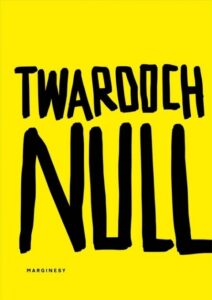
This is a dark, gripping novel of the Russian invasion of Ukraine from one of Poland’s bestselling writers. Based on Szczepan Twardoch’s own experience delivering aid to Ukrainian soldiers, Null captures the personal and moral dilemmas of soldiers’ lives in a war with no end in sight.
The novel takes place in a series of squalid dugouts a few miles from the front line. The main character, known only by the codename ‘Horse’, is a Polish volunteer into the Ukrainian army, motivated by his anger at the war and a desire to flee his dysfunctional life at home. He and his comrades, a motley crew of volunteers and unwilling draftees, are bound together by their care for one another in a situation of seeming futility. Their boredom and alienation is punctuated by moments of frenzied chaos, as Russian attacks force them from one position to another. Their lives – and deaths – on the front seem dictated not by a cause or great strategy, but the random chance of an artillery hit from miles away or stumbling across a hostile drone. These adrenaline-pumping sequences drive the narrative forward and are a potent reminder that this war, so often portrayed in the media as a stalemate, is still very much ‘hot’.
Null is an outstanding entry in the canon of war literature. Twardoch tells his story in textured, Ukrainian-inflected prose, using second-person narration, which brings the reader directly into the story. Above all, he probes the many contradictions of a seemingly just war, one in which a moral cause does not always translate into moral means.
Sean Gasper Bye
Selected samples



She climbed her first peaks in a headscarf at a time when women in the mountains were treated by climbers as an additional backpack. It was with her that female alpinism began! She gained recognition in a spectacular way. The path was considered a crossing for madmen. Especially since the tragic accident in 1929, preserved … Continue reading “Halina”

First, Marysia, a student of an exclusive private school in Warsaw’s Mokotów district, dies under the wheels of a train. Her teacher, Elżbieta, tries to find out what really happened. She starts a private investigation only soon to perish herself. But her body disappears, and the only people who have seen anything are Gniewomir, a … Continue reading “Wound”

A young girl, Regina Wieczorek, was found dead on the beach. She was nineteen years old and had no enemies. Fortunately, the culprit was quickly found. At least, that’s what the militia think. Meanwhile, one day in November, Jan Kowalski appears at the police station. He claims to have killed not only Regina but also … Continue reading “Penance”

The year is 1922. A dangerous time of breakthrough. In the Eastern Borderlands of the Republic of Poland, Bolshevik gangs sow terror, leaving behind the corpses of men and disgraced women. A ruthless secret intelligence race takes place between the Lviv-Warsaw-Free City of Gdańsk line. Lviv investigator Edward Popielski, called Łysy (“Hairless”), receives an offer … Continue reading “A Girl with Four Fingers”

This question is closely related to the next one, namely: if any goal exists, does life lead us to that goal in an orderly manner? In other words, is everything that happens to us just a set of chaotic events that, combined together, do not form a whole? To understand how the concept of providence … Continue reading “Order and Love”


The work of Józef Łobodowski (1909-1988) – a remarkable poet, prose writer, and translator, who spent most of his life in exile – is slowly being revived in Poland. Łobodowski’s brilliant three- volume novel, composed on an epic scale, concerns the fate of families and orphans unmoored by the Bolshevik Revolution and civil war and … Continue reading “Ukrainian Trilogy: Thickets, The Settlement, The Way Back”


