Poetry is like any daily routine: repetition with sudden swerves, i.e., ‘miracles’
Dreaming Modernism
Let’s go, little star, with the smoke, past air,
resistance, lights long as drowsy flames,
and dark, which you put up like hands –
tell us, please, how do you make money?
Lights brief as shared air, resistance,
let’s go with the smoke, little star, past flames –
listen, please, how do I throw up my hands,
dark as the tomb where I make money?
Let’s go with the smoke, past the flames, little star,
the lights as long as the air we share, resistance,
you’re bright as the tomb as I throw up my hands –
tell me, please, how do you make money?
Lights as long as air we’ve gone past, little star,
let’s go with the smoke like drowsy flames, resistance,
please don’t tell us, how do you raise your hands,
you, lofty as the tomb where you make money?
Stirring: Glowworm
It uncoiled and licked till she lost
her lips. Pale and even, very,
very tight. Sickening as crab apple,
mighty as a castle, tart
as earth. Even dead
it fruits each night with light.
Stirring: Dark Circles
This time it will start
under the cold light
swelling from the lumens
per linear metre. Quiet,
cold flashes
in the eyes and ears.
Stirring: Fill Me with Love
Forget the snow, you’re visible.
Forget the snow, you’re vulnerable.
Forget, now they’re stirring, now they’re looking.
Translated by Benjamin Paloff
Poetry is like any daily routine: repetition with sudden swerves, i.e., ‘miracles’
Jakub Sęczyk’s poems are spare, laconic and at times strategically withholding. They call to mind the observational logic of the Objectivist poems of the mid-20th century, with their close attention to the natural appearance and sound of things, only with an essential, pronounced caveat: in the media-saturated environment of the early 21st century, with its deepfakes, robocalls and retail politics, the attentive mind has learned to distrust that anything is what it seems to be, or that there is any longer the possibility of seeing and hearing things as they really are, including one’s own feelings and interior perceptions.
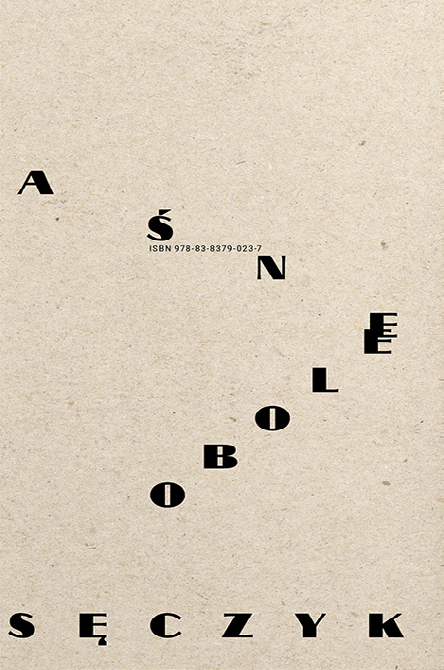
Sour Obols, Sęczyk’s follow-up to his award-winning 2022 volume Święta pracy (Work Holidays), mines demotic language and the mounting anxieties of daily life in late capitalism to find museum-worthy artefacts of beauty and heartbreak: the shattering revelation that emerges from a slightly misheard cliché, the impression of light that breaks through – or crashes into – sleep and/or love. These are poems that, in their often radical concision, seem like they’ve ended before they’ve begun, and that therefore must be repeated, though it is the rereading itself that reveals how nothing can ever be truly repeated. Like the ‘obols’ referenced in the collection’s title, what was once valuable enough to kill for or to bury with the dead will eventually become one with the dirt, only to be rediscovered later as treasure.
Benjamin Paloff
Selected samples
She climbed her first peaks in a headscarf at a time when women in the mountains were treated by climbers as an additional backpack. It was with her that female alpinism began! She gained recognition in a spectacular way. The path was considered a crossing for madmen. Especially since the tragic accident in 1929, preserved … Continue reading “Halina”
First, Marysia, a student of an exclusive private school in Warsaw’s Mokotów district, dies under the wheels of a train. Her teacher, Elżbieta, tries to find out what really happened. She starts a private investigation only soon to perish herself. But her body disappears, and the only people who have seen anything are Gniewomir, a … Continue reading “Wound”
A young girl, Regina Wieczorek, was found dead on the beach. She was nineteen years old and had no enemies. Fortunately, the culprit was quickly found. At least, that’s what the militia think. Meanwhile, one day in November, Jan Kowalski appears at the police station. He claims to have killed not only Regina but also … Continue reading “Penance”
The year is 1922. A dangerous time of breakthrough. In the Eastern Borderlands of the Republic of Poland, Bolshevik gangs sow terror, leaving behind the corpses of men and disgraced women. A ruthless secret intelligence race takes place between the Lviv-Warsaw-Free City of Gdańsk line. Lviv investigator Edward Popielski, called Łysy (“Hairless”), receives an offer … Continue reading “A Girl with Four Fingers”
This question is closely related to the next one, namely: if any goal exists, does life lead us to that goal in an orderly manner? In other words, is everything that happens to us just a set of chaotic events that, combined together, do not form a whole? To understand how the concept of providence … Continue reading “Order and Love”
The work of Józef Łobodowski (1909-1988) – a remarkable poet, prose writer, and translator, who spent most of his life in exile – is slowly being revived in Poland. Łobodowski’s brilliant three- volume novel, composed on an epic scale, concerns the fate of families and orphans unmoored by the Bolshevik Revolution and civil war and … Continue reading “Ukrainian Trilogy: Thickets, The Settlement, The Way Back”