This is the music the band plays on the Titanic of late capitalism

That was the day I made the ultimate decision concerning my life and carried it in my heart as I shoved my way through the already thinning crowd, squeezing a pen drive in my hand. As if they knew, the waves of people headed in various directions tried again and again to bring my effort to nought, carrying me to a completely different place on the square than the one I was aiming for; milling around everywhere were sexy little children and aggressive packs of girls with bushy, tousled lashes that hid eyes glowing with sexual PTSD and a readiness for unyielding confrontation.
They had skimpy jackets, beneath which you could see their lovely, ice-cold, extensively frostbitten tummies. […]
I finally succeeded in pushing through to the pedestrian underpass: there was an internet café where I intended to print out my letter of resignation – and thus to bid farewell to the old life and get the new one started. To my surprise, like an omen, I saw the familiar hotel receptionist behind the counter. She was evidently alive and working here after leaving the hotel.
Which, next to this place, maybe seemed a bit decrepit, but nonetheless like a luxury facility: the café’s interior was squalid, and it reeked. Since the computers were either missing or broken, people with alcohol use disorder were resting at the stations; it was like this was their shelter, and the receptionist was providing them palliative care.
‘I remember you perfectly from the hotel,’ she said, having made peace with her professional degradation, and somehow rather proud of it.
But because I had been certain for some time that she was dead, it seemed as if I were being sermonised to by a corpse. Her forearms looked like someone had been trying to make a living tartare out of them, and it hadn’t been easy, but they’d succeeded.
‘You and your friends. It’s wonderful how love can prevail even between distant acquaintances.’ She noticed my gaze on her arms and took a sip from the small bottle next to the printer, filled with the cheapest, yogurt-covered-strawberry-and-nut-granola-flavoured vodka. ‘Oh this?’ she added with a smile, indicating the expansive palimpsest of deep, chaotic cuts. ‘Please don’t be grossed out: it’s a wonder wound. It never closes, or heals. The enchanted suffering within is constantly self-renewing, spurring and bringing forth infinite benefits. You can ask it for anything, and it’ll be fulfilled. A couple people have already done it, and a couple days ago one of these guys here even won the Eurojackpot!’
Burping softly, she pointed toward the wall, where amidst the garbage and old, eviscerated IBMs I noticed two men lingering, deep in sleep, or else maybe even deceased.
‘They had dreamed of taking a trip abroad. An expedition to exotic islands! But they were shot down. So now that might be unrealistic, to be honest.’
Indeed: they put out a vacation vibe, in the wrong way. Tragicomically relaxed, their arms thrown to the side as if performing a Sun Dance. Beside them lay a tattered MediaMarkt bag, a couple of sandy oyster shells, and several bottles of pricey Moët & Chandon, and one of them recalled… At once I looked at him more closely, more attentively, because he was confusingly similar to a man with no arms…
Translated by Benjamin Paloff
This is the music the band plays on the Titanic of late capitalism
Translation rights: Monika Regulska, monika@syndykatautorow.com.pl
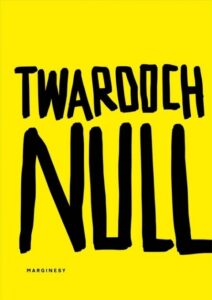
A hapless young man struggles to figure out his place in a family that sees him only as the absence of a loved one long dead. A disappointed lover weighs the possibility of building a new life for herself in a celebrity-obsessed provincial town that is literally collapsing in illusion around her. Rather than its promised portal to a world of cosmopolitan creativity, an international artist’s residency brings only isolation and a live-action demonstration of a writer’s own irremediable foreignness. A food service job seems like a dead end, but not because the worker had studied sociology: that, at least, couldn’t be more useful for dealing with an endless stream of oblivious customers.
Drawing from the ever-deepening well of sharp wit, acute social observation, and linguistic virtuosity that she has continued to fill throughout an extraordinarily diverse career, with Wonder Wound Dorota Masłowska has forged a new Dubliners for the 21st century. Here we find as much high comedy and heartbreak, blistering satire and trenchant critique – sometimes by turns, usually all at once – as readers have come to expect from one of Poland’s – and world literature’s – most reliably innovative voices. In these thematically intertwined, phantasmagoric short stories, Masłowska demonstrates time and again how dream and nightmare are merely two ways of looking at the same thing. And she achieves this once again in masterfully sculpted prose that is as propulsive as it is challenging, jumping mid-sentence from lyric metaphor to advertising jingle to political boilerplate. This is a book that demands to be read, heard and translated with a finely tuned ear.
Benjamin Paloff
Selected samples



She climbed her first peaks in a headscarf at a time when women in the mountains were treated by climbers as an additional backpack. It was with her that female alpinism began! She gained recognition in a spectacular way. The path was considered a crossing for madmen. Especially since the tragic accident in 1929, preserved … Continue reading “Halina”

First, Marysia, a student of an exclusive private school in Warsaw’s Mokotów district, dies under the wheels of a train. Her teacher, Elżbieta, tries to find out what really happened. She starts a private investigation only soon to perish herself. But her body disappears, and the only people who have seen anything are Gniewomir, a … Continue reading “Wound”

A young girl, Regina Wieczorek, was found dead on the beach. She was nineteen years old and had no enemies. Fortunately, the culprit was quickly found. At least, that’s what the militia think. Meanwhile, one day in November, Jan Kowalski appears at the police station. He claims to have killed not only Regina but also … Continue reading “Penance”

The year is 1922. A dangerous time of breakthrough. In the Eastern Borderlands of the Republic of Poland, Bolshevik gangs sow terror, leaving behind the corpses of men and disgraced women. A ruthless secret intelligence race takes place between the Lviv-Warsaw-Free City of Gdańsk line. Lviv investigator Edward Popielski, called Łysy (“Hairless”), receives an offer … Continue reading “A Girl with Four Fingers”

This question is closely related to the next one, namely: if any goal exists, does life lead us to that goal in an orderly manner? In other words, is everything that happens to us just a set of chaotic events that, combined together, do not form a whole? To understand how the concept of providence … Continue reading “Order and Love”


The work of Józef Łobodowski (1909-1988) – a remarkable poet, prose writer, and translator, who spent most of his life in exile – is slowly being revived in Poland. Łobodowski’s brilliant three- volume novel, composed on an epic scale, concerns the fate of families and orphans unmoored by the Bolshevik Revolution and civil war and … Continue reading “Ukrainian Trilogy: Thickets, The Settlement, The Way Back”


